

In The Spotlight

Image by Ted Erski from Pixabay
Until we stop labelling followers as leaders and placing them in important positions, our woes will know no end. In an ideal world, nations are led by visionary individuals who possess the necessary skills, integrity, and dedication to serve the greater good. However, far too often, we witness the replacement of true leaders with managers and businessmen whose primary focus is personal gain rather than the well-being of the citizens they are entrusted to govern.
The consequences of this troubling trend are nothing short of disastrous. Until we stop labelling followers as leaders and placing them in important positions, our woes will know no end. In an ideal world, nations are led by visionary individuals who possess the necessary skills, integrity, and dedication to serve the greater good. However, far too often, we witness the replacement of true leaders with managers and businessmen whose primary focus is personal gain rather than the well-being of the citizens they are entrusted to govern. The consequences of this troubling trend are nothing short of disastrous.
Managers and businessmen, by the nature of their training and experience, are not equipped to navigate the complex challenges of governing a country. Their expertise lies in maximizing profits and, not in crafting long-term and strategic policies that address the needs of the people. When these individuals are placed in positions of power, they struggle to connect with the aspirations and struggles of the common citizen, instead prioritizing policies that serve their interests and that of their sponsors.
Labeling Followers as Leaders -A Recipe for Disaster
To make matters worst, is the practice of labeling followers as leaders, a misguided attempt to create the illusion of strong leadership. These so-called "leaders" are often individuals who have gained the support of a vocal minority but lack the vision, decision-making skills, and ability to inspire and unite the masses. When these followers are elevated to positions of authority, the results are catastrophic.They lack the necessary political acumen, the courage to make difficult choices, and the commitment to the greater good, instead enacting policies that benefit their loyal base at the expense of the nation.
As these managers, businessmen, and labeled followers ascend to positions of power, the impact on the citizens they are meant to serve is nothing short of devastating. Infrastructure crumbles, social services deteriorate, and economic prosperity stagnates, all while these individuals pursue their agendas.The people who had placed their trust in these supposed leaders become disillusioned and disenfranchised, leading to a breakdown in social cohesion.
To break this vicious cycle, it is crucial that we, as a society, reject the practice of appointing individuals based on family connections, personal friendships, or political allegiances. Instead, we must demand a true meritocracy, where leaders are selected based on their proven track record of excellence, vision, and unwavering commitment to serving the people.
These leaders must possess the necessary skills to navigate the complex challenges of governance, the emotional intelligence to connect with the diverse needs of the citizenry, and the courage to make tough decisions that may not always be popular but are ultimately in the best interests of the nation. They must be individuals who have earned the trust and respect of the people through their actions, not through empty promises or political maneuvering.
By embracing the principles of meritocracy and rejecting the temptation to replace true leaders with managers, businessmen, and labeled followers, we can reclaim the promise of effective, visionary leadership. This, in turn, will pave the way for a future where prosperity, progress, and the well-being of all citizens are the top priorities, rather than the personal gains of a select few.
It is time for us, as engaged citizens, to demand the highest standards of leadership and to hold our elected officials accountable. Only then can we ensure that our nations are governed by individuals who are truly dedicated to serving the greater good, rather than their narrow interests.
Desmond John Beddy



More News

Photo: Alex Robinson -Unsplash

TopAfric Ladies


Joel Amankwah


Subscribe now


Empowering Tomorrow's Craftsmen
In a world where collaboration often leads to extraordinary achievements, the partnership between TopAfric, the organizers of the African Youth Education Awards (AYEA), and the Hamburg Chamber of Crafts (Handwerkskammer) is nothing short of remarkable.
This alliance promises to bring forth a myriad of opportunities and benefits for young Africans seeking to explore the world of craftsmanship and trades. The joint participation in the AYEA 2023 event on Saturday, 4th November 2023, at the Chambers of Commerce in Hamburg is a testament to their shared vision.
AYEA's core objective is to celebrate the educational accomplishments of young African individuals in Germany. By partnering with the Hamburg Chamber of Crafts, AYEA extends its support and recognition to a wider array of talents, especially those venturing into the world of craftsmanship. This collaboration will unlock opportunities for young individuals who aspire to pursue vocational training and technical education. It provides them with a platform to showcase their talents and skills, opening doors to fulfilling careers.
The Hamburg Chamber of Crafts has a rich legacy of promoting vocational training and skill development. By joining forces, TopAfric and the Handwerkskammer can empower young Africans in Germany with the skills and knowledge needed to excel in various crafts and trades. This empowerment is not only about enhancing their employability but also about nurturing their self-confidence and self-sufficiency. Craftsmanship offers the chance for individuals to hone their abilities and craft a successful future.
The field of craftsmanship is not immune to change; it evolves with time and technological advancements. By collaborating, AYEA and the Handwerkskammer can encourage innovation and the adoption of modern techniques within the African community. This partnership offers young talents the opportunity to explore, adapt, and contribute to innovative developments in craftsmanship. It positions them as agents of progress in the evolving world of trades.
The beauty of this partnership lies in its ability to champion inclusivity and diversity within the craft sector. It paves the way for African youth in Germany to explore vocational and technical professions without prejudice. By embracing diversity, this collaboration enriches the craft community with fresh perspectives, ideas, and approaches. It serves as a testament to the fact that talent knows no boundaries.
Vocational education and technical professions often face challenges in attracting young talents. Many individuals are unaware of the promising career opportunities that lie within the craft sector. The collaboration between AYEA and the Hamburg Chamber of Crafts acts as a bridge. It bridges the information gap and aids young Africans in making informed choices regarding their educational and career paths.
Partnering with an esteemed institution like the Hamburg Chamber of Crafts widens the horizons for AYEA. It opens doors to a broader network of professionals, mentors, and potential employers. This expanded network is a treasure trove of opportunities for African youth, providing mentorship, internships, and job openings. The alliance strengthens the support system for young talents.
AYEA's emphasis on education aligns seamlessly with the Handwerkskammer's dedication to vocational training. By working in tandem, both organizations contribute to the long-term sustainability of educational programs and support systems for African youth in Germany. This commitment to sustainability ensures that young individuals have continuous access to resources, knowledge, and guidance on their journey.
The collaborative participation of TopAfric and the Hamburg Chamber of Crafts in AYEA creates awareness within the African community about the significance of vocational and technical education. It underscores the importance of craftsmanship and its role in fostering self-reliance, entrepreneurship, and economic sustainability. By shedding light on these opportunities, it encourages more young individuals to explore and embrace the world of trades.
The partnership is a transformative step towards empowering young African individuals. It nurtures their aspirations, enhances their skills, and opens doors to fulfilling careers in craftsmanship. This collaboration is a beacon of inclusivity, innovation, and sustainability, ensuring that the future generation has the tools and knowledge needed to shape their destinies in a rapidly evolving world.
Desmond John Beddy

Desmond John Beddy
The prospect of departing this world with a lingering sense of unfulfillment weighs heavily on my heart. My earliest school memories take me back to a dilapidated classroom situated in a town deprived of fundamental amenities like electricity, clean drinking water, and a clinic.
Today, I find myself questioning, "What have I given back to this community?" The response to this question is profoundly disheartening—nothing.
From a young age, I grasped the principle that those who are fortunate must also give generously in return. It's important to note that this giving is not limited to monetary contributions; it also involves sharing un-used clothing with those in desperate need. Regrettably, I must confess that I have not done enough in this regard.
My dear friend, I trust that you can empathize with my frustration. I understand that it's implausible to fulfill all of my dreams, yet I remain convinced that there's much more I can achieve. The same potential exists for you.
I've frequently pondered the notion of what transpires if my noble intentions and visions go unrealized. In fact, I previously emphasized this point in Nürnberg, Germany when I received recognition for my community contributions: "Success is only achieved when you have prosperous successors who carry forward your work."
Is it not plausible that, were I to pass away today, the distinguished African Youth Education Awards (AYEA) might slip into obscurity? Success transcends the mere initiation of endeavors; it hinges on guaranteeing their long-term sustainability.
Far too often, we are inclined to launch fresh initiatives while abandoning existing projects—both in our home countries and abroad. We frequently prioritize the creation of new endeavors catering to the elite, neglecting those aimed at uplifting the underprivileged.
I am acutely aware that my grave might bear witness to my sorrow as I witness the marginalized status of the vulnerable. For several years, I have advocated for the principles of "Come Together, Work Together, and Stay Together" (CWS) to no avail.
Coming together for a shared purpose constitutes only the inaugural step; it's equally vital that we continue working together and, most importantly, stay united. Within this unity, teams grow stronger, deficiencies are addressed, and we achieve medium and long-term objectives.
A close friend once commended my achievement in compiling "The History of Ghanaians in Germany." However, I am unable to rest content until millions have access to the book, millions have perused its contents, and it has significantly impacted lives.
My aspiration is to see the book meticulously edited and readily available in all German schools, universities, libraries, cultural centers, and social hubs. Unfortunately, this vision remains unfulfilled.
Despite my profound love for writing and an unwavering passion to effect change, I have failed to write consistently. I acknowledge that I haven't done enough, despite possessing the means to contribute more. Were I to depart today, my soul would bear the burden of an unfulfilled purpose until the end of time.
Desmond John Beddy
https://www.beddy.de
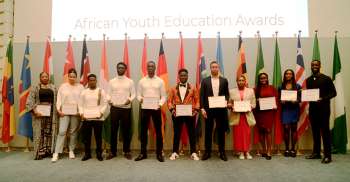
African Youth Education Awards -2022
Although the Covid-19 pandemic was a huge distraction in terms of planning and implementation, TopAfric e.V. was able to run the “Youth Leadership Programme” successfully. The mentoring programme aimed to deepen educational awareness and empower young people of African descent in Germany. It aimed at creating a spontaneous willingness on the part of the youth to become involved in civic engagements, strengthen social cohesion, and charge them with being more socially responsible.
The programme brought together mentees and working mentors to exchange views on various topics based on mutual respect and understanding. The project pursued active community building with the aim of networking and improving the academic and professional qualifications of the mentees. The young people benefitted greatly from the experiences and skills of the mentors, while the mentors had the privilege of sharing their successes and setbacks productively and passing on their experiences to the younger generation. The programme was implemented within two years with some challenges along the way, but these were managed well by the mentors and mentees.
The mentees were actively involved in the activities of TopAfric e.V. by accompanying people to offices, assisting them in filling out forms and providing translations in schools for parents who are not fluent in the German language. Though not part of the initial plans, the African students from Ukraine were supported by helping them to find accommodation and searching for German-language schools, as well as organizing Zoom seminars for them on how to navigate their stay in Germany.
The African Youth Education Awards (AYEA) that crowned the project were amazing and witnessed the biggest attendance since 2012. Initially, the event was slated for the 15th October 2022, but two months before that date, the Chamber of Commerce had to change our schedule to the 22nd October 2022. Panic broke out as we had to create additional posters, flyers and promotional videos. The new young team was able to adjust quickly to implement the programme in an amazing way. Over 500 people attended, far exceeding the target of 300 people, with the participation of state institutions, consulates, embassies, and agencies from Africa, leaders from the African communities and members of the media. The ripple effect went far beyond the attendees.
The mentoring programme builds on the activities of TopAfric e.V. and its network of partners in the field of educational equity and empowerment. The mentees did not only participate in the programmes we run, but took up leadership roles and helped operate them successfully.
We wish to express our sincere gratitude to Aktion Mensch which sponsored the leadership programme. With Covid-19 gone, we would be in a better position to implement such a noble project more successfully.
Desmond John Beddy
https://beddy.de

Adaklu -Blidokope Basic School
Building a new school and borehole is a significant milestone in the development of a community, particularly in areas where access to education and clean water is limited. Adaklu Blidokope, a small village in the Volta Region of Ghana, completed the construction of a six-unit classroom, a store, a teachers' office, and a borehole with the help of TopAfric, a non-governmental organization based in Germany.
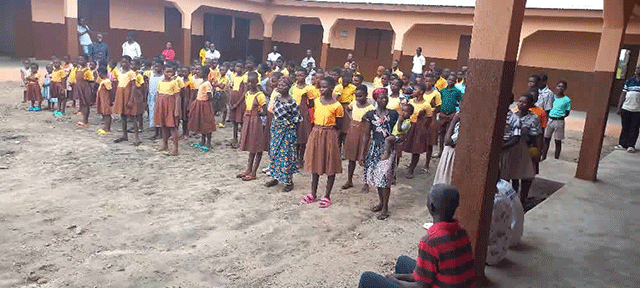
For years, the children of Adaklu Blidokope were attending classes under trees or in a dilapidated classroom block that posed risks to their safety and hindered their ability to learn effectively. Recognizing the importance of education in transforming lives and boosting community development, the Adaklu Blidokope community sought assistance from TopAfric to raise funds for the construction of a new school and a borehole.
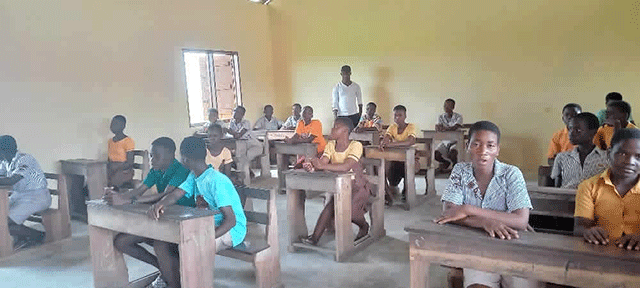
The completion of the six-unit classroom, store, and teachers' office signifies a new chapter in the lives of the children in the immediate communities. With proper infrastructure, these children can now learn in a safe and conducive environment that promotes effective teaching and learning. The new facilities will also attract qualified teachers who are essential in providing quality education to the students.
In addition to the school building, the construction of a borehole is another significant achievement for the community. Access to clean water is crucial for the well-being and health of the community members. Prior to the borehole's completion, the community relied on open water sources, which were often contaminated and posed serious health risks. The provision of clean water through the borehole will greatly improve the living conditions of the community, reducing the prevalence of waterborne diseases and saving precious time previously spent on searching for water.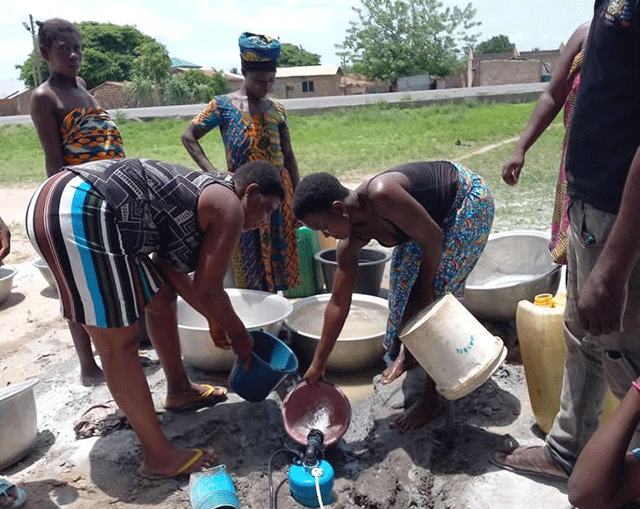
Unfortunately, the borehole could not yield enough water as anticipated.
The successful completion of the school building and borehole in Adaklu Blidokope is a testament to the power of collaboration and the impact that non-governmental organizations can have on transforming communities. It highlights the determination and resilience of the community in their pursuit of a better future for their children.
The partnership between the community and TopAfric exemplifies the significance of international cooperation in addressing the challenges faced by disadvantaged communities. By leveraging resources and expertise from different parts of the world.
Challenges Faced:
Inflation:
The project encountered a significant challenge in the form of inflation, which led to an explosion in the prices of building materials and labour costs. This unexpected surge in costs had a profound impact on the project budget, necessitating careful financial management and adjustment of expenditure priorities.
Work Ethic of Workers:
Another challenge faced during the project was related to the work ethic of the people. Workers often started their tasks late and closed early, displaying a lack of respect for scheduled work hours. This issue not only affected project timelines but also added to the overall project complexities.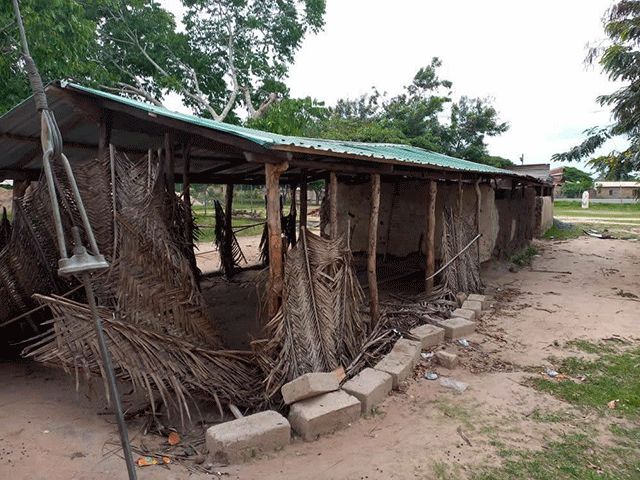
Project Delays:
Due to the combined impact of inflation and the inconsistent work ethic of the labour force, the project could not be completed as initially scheduled. Delays in construction timelines presented additional challenges, including increased costs and disruptions in the community's access to the new facilities.
The completion of the school building and borehole not only provides immediate benefits to the community but also holds the promise of a brighter future. Education is a powerful tool that empowers individuals and communities, and access to clean water is essential for health and well-being.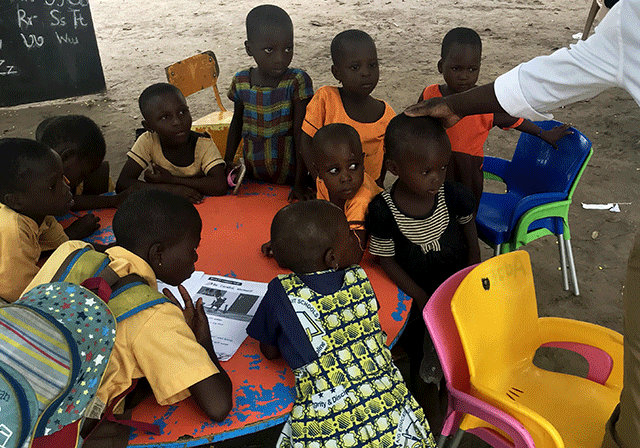
Finally, a million thanks to you…
We could not have done it without your support.
Desmond John Beddy
Foto by Ifeoluwa A
Neo-colonialism: The Last Stage of Imperialism is a seminal work by Kwame Nkrumah, the first President of Ghana and a leading figure in the African independence movement. Published in 1965, the book offers a critical analysis of the re-emerging form of imperialism known as neo-colonialism, which perpetuates the dominance of former colonial powers over newly independent African nations through indirect means.
Nkrumah begins by tracing the historical development of imperialism, highlighting how colonial powers exploited and subjugated Africa during the era of direct rule. He then identifies the transition from formal colonialism to neo-colonialism, arguing that the colonizers, unable to maintain direct control over the colonies, devised new strategies to maintain their economic and political influence in Africa.
According to Nkrumah, neo-colonialism involves the establishment of puppet regimes in newly independent states that appear to exercise sovereignty, while in reality, they continue to adhere to the interests of former colonial powers. He argues that these puppet leaders are selected and supported by the colonial powers, enabling them to maintain control over key resources and perpetuate economic exploitation in Africa.
Nkrumah explores the various tactics employed by neo-colonial powers to continue their influence. One of the main strategies is economic manipulation, in which multinational corporations from the former colonial powers use their economic power to exploit African resources and maintain control over local industries. Additionally, he discusses the role of foreign aid, arguing that it often serves as a tool for perpetuating dependency, rather than facilitating meaningful development.
Furthermore, Nkrumah highlights the importance of ideological control in neocolonialism. He argues that former colonial powers maintain their influence by promoting ideologies and cultural norms that serve their interests and suppress indigenous African values. This is achieved through the dissemination of educational materials, media control, and the propagation of Western cultural values.
Nkrumah also emphasizes the need for African nations to unite in order to combat neo-colonialism effectively. He argues for the creation of a continental union, emphasizing the importance of pan-Africanism and the necessity of African nations working together to resist foreign dominance. Furthermore, he advocates for the establishment of self-reliant economies and the implementation of socialist policies to drive national development.
In summary, Kwame Nkrumah's book provides a comprehensive analysis of neo-colonialism, outlining the tactics and strategies employed by former colonial powers to maintain control and exploit Africa even after achieving formal independence. He calls for unity among African nations, resistance against foreign influence, and the pursuit of self-reliant development to break free from the constraints of neo-colonialism. Nkrumah's work remains a significant contribution to understanding the ongoing struggles faced by African nations in the post-colonial era.
Desmond John Beddy
https://beddy.de
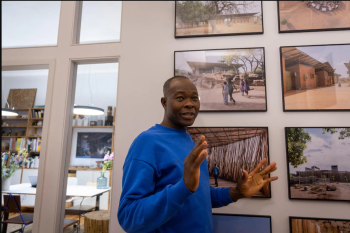
For the first time in its history, architecture's most prestigious award has been won by an African.

‘It’s not just about my experience and my sympathy, it is about the community who needs a voice at the local assembly, we must therefore do everything necessary to be part of the political dispensation’.
Irene was a guest on the Effiya Ephya Show in the studios of Radio TopAfric. The interview was about the upcoming European and Hamburg district elections ‘Bezirksversammlungswahl’. The elections are taking place on Sunday, 26 May 2019.
Born and bred in Hamburg-Billstedt, Irene Appiah is a mother and works with the Hamburg Ministry of Education ‘Schulbehörde’. The seasonal politician is a member of the Social Democratic Party (SPD) and is of African heritage, born in 1976 to Ghanaian parents.
She is contesting the Hamburg-Mitte local assembly elections and is seeking the assistance and support of the community to make it.
Question: Who can vote?
Irene:
Persons who are 16 years and above.
Persons who are registered in Hamburg-Mitte for at least six months.
Persons who hold an EU and/or German passport.
Question: Do you have what it takes to represent your people?
Irene:
Yes, long before I entered into politics, I have been a community activist, representing my people, helping with complex bureaucratic issues. My background as a solicitor has been very useful. Besides it is no longer about me, but about us. We have the numbers and must therefore use it to our advantage.
If we are able to mobilise our people well, we can make it. I will then be in a better position to help create educational opportunities for children of African heritage, help establish extra classes, continue with the African Community Centre, which we have already started. Remember most of our people are facing accommodation problems; we can help address this properly.
Question: How can one vote for you?
Irene:
The postal voting system ‘Brierfwahl’ is the most ideal and comfortable way of voting, all eligible voters have been sent voting documents. Those who have not received them could apply at their various district assemblies ‘Bezirksamt – Wahldienstelle’. In my case Bezirksamt Hamburg-Mitte.
The documents include two voting sheets
1. Pink sheet, you can locate my name (Irene Appiah) on position six. Please, cross all five positions in front of my name.
2. Yellow sheet, my name (Appiah Irene) is placed at position 10, cross all five boxes for me. I will appreciate it most if people could take advantage of the postal voting.
Question: What should one do on the actual poll date?
Irene:
On Sunday, the polling stations are open from 8.00 am till 18.00. Eligible voters are encouraged to go and cast their votes. As stated earlier, residents of Hamburg-Mitte, which comprises of the following townships:
Billbrook, Billstedt, Borgfelde, Finkenwerder, HafenCity, Hamburg-Altstadt, Hamm, Hammerbrook, Horn, Kleiner Grasbrook, Neustadt, Neuwerk, Rothenburgsort, St. Georg, St. Pauli, Steinwerder, Veddel, Waltershof and Wilhelmsburg, can vote for me.
In addition, those in Billstedt can also use the pink sheet to vote for me.
Question: What message do you have for your people?
Irene:
I have been serving and representing the interests of the African community and will continue to do so. We have the numbers; we have the people and the competence to be relevant in Germany. Let’s be politically active and participate in taking decisions that concern us. If we refuse and fail to exercise our voting rights, others will decide for us.
I am confident we won’t allow this opportunity to escape us, go and vote, and vote for me.
One can reach Irene as follows:
t: 040 246989
e: This email address is being protected from spambots. You need JavaScript enabled to view it.
w: www.spd-hh-mitte.de
f: Irene.appiah.5

Many new laws and legislative changes, affecting employees, the unemployed, families and retirees, came into force on 1 January 2019. The African Courier takes us through some of the most important changes that we should know.
Minimum wage rises
The statutory minimum wage (der gesetzliche Mindestlohn) rises from 8.84 euros to 9.19 euros on 1 January 2019. From 2020, employers will have to pay at least 9.35 euros per hour.
Several industry minimum wages have also risen, for example, in the roofing trade, in the electrical trade, in the building cleaning trade, and in the temporary work and care sectors.
Because a job is subject to social insurance if the earnings limit of 450 euros per month is exceeded, those who want to avoid this would have to reduce the working time accordingly.
More time for filing tax return
From 2019, taxpayers will have two months longer to submit their annual tax return (Abgabe der Steuererklärung). Those who submit their tax returns themselves have time to file their returns for 2018 until 31 July 2019. For taxpayers represented by a tax advisor, the deadline will be extended from the end of the year to the 28th of February of the following year. For example, the tax return for 2018 will then be due latest 28 February 2020.
However, whoever does not submit the tax declaration on time must automatically pay a delay fine.
Higher tax allowance
Income tax is now payable only on an income of more than 9,168 euros (steuerlicher Freibetrag) per year – that is, 168 euros more than in 2018. For jointly assessed couples, the threshold rises to 18,336 euros.
Statutory health insurance for self-employed persons cheaper
For full-time self-employed persons with low incomes, the minimum premium in the statutory health insurance (gesetzliche Krankenkasse) has now been reduced from around 360 euros to about 156 euros per month. The reason: Since 1 January 2019, the minimum assessment basis (Mindestbemessungsgrundlage) for membership in the statutory health insurance for the self-employed has been reduced to 1,038.33 euros (it was 2,284 euro in 2018).
Making calls abroad becomes cheaper
Roaming charges have been history since 2017. Now phone calls and the sending of text messages to other EU countries will become cheaper this year. From mid-May 2019, the price of international calls will be capped at 19 cents per minute. SMS will cost a maximum of six cents.
CHANGES AND NEW LAWS FOR FAMILIES
More child benefit
Child benefit (Kindergeld) will be increased from 1 July 2019. Parents will get 204 euros/per child for the first and second child; 210 euros for the third child; and 235 euros a month for each additional child.
Higher tax deduction for children
The tax exemption for dependent children (Kinderfreibetrag) has been increased, starting from January, to 2490 euros or for both parents to 4980 euros when assessed together.
Child maintenance allowance rises
The alimony payments for children of separated parents (Unterhalt für Trennungskinder) have also been increased. From 1 January 2019, the minimum maintenance allowance payable for children under the age of seven will be 354 instead of the previous 348 euros per month. Seven to twelve-year-olds now get 406 instead of 399 euros. Children from 13 to 18 are entitled to a monthly allowance of 476 euros, it was formerly 467 euros. The minimum allowance for children of full age remains unchanged.
CHANGES FOR THE UNEMPLOYED
Increase in Hartz IV benefit
The standard rates for social assistance and unemployment benefit II (Sozialhilfe und Arbeitslosengeld II) have been increased. Single parents and persons living alone will now receive 424 instead of 416 euros. If you live with another needy person in the same household, you will receive 382 euros instead of 374 euros. The standard rate for children up to five years rises to 245 euros a month, and those from six to 13 years receive 322 instead of 316 euros.
Changes in Unemployment Benefit I
Previously, jobseekers must have held a job that made contribution to the unemployment insurance scheme for 12 months within the last 24 months prior to filing their application to be qualified to draw Unemployment Benefit I (Arbeitslosengeld I). From 1 January 2019, twelve months within the last 30 months are now sufficient to qualify for the benefit
Support for the long-term unemployed
For the long-term unemployed, state-funded jobs are now possible for re-entry into working life. Employers receive money from the state for five years to pay the employee: In the first two, labour costs are paid in full, and then the subsidy goes down by ten percentage points every year. Condition for qualification for the scheme is that the long-term unemployed is older than 25 years and has received Hartz IV for at least six years within seven years.
CHANGES FOR RETIREES
Increase in disability pension benefit
Disability pensioners will receive significantly more benefit if they retire from 2019. The pension (Erwerbsminderungsrente) will now be calculated as if the person concerned had worked until the standard retirement age – not like until now 62 years.
Pensioners pay more tax
Anyone who retires this year has to pay more tax on their pension income. From January 2019, the taxable portion of pension (Steuerpflichtiger Teil der Rente) increases from 76 to 78 percent. Thus, only 22 percent of the first full gross annual pension remains tax-free. This percentage applies only to persons retiring as from 2019.
© The African Courier/Femi Awoniyi
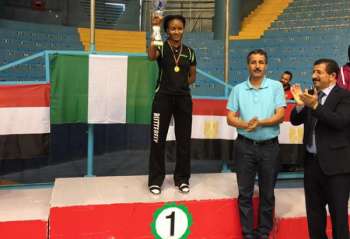
Several years after ruling the continent, Nigeria’s Olufunke Oshonaike yesterday turned the clock back to emerge as the new African champion in the women’s single event of the 2016 ITTF Africa Senior Championships in Agadir, Morocco. As the second seeded player in the competition, Oshonaike has never beaten the young Egyptian in the last two years but the tide turned in favour of the Nigerian as the North African tasted the first defeat in the continent to surrender the title.
From the start of the encounter, Oshonaike took charge taking a 2-0 lead but the Egyptian restored parity at 2-2. Oshonaike then decided to play with a lot of caution and tactics which eventual confused her opponent who finally succumbed to the more experienced Nigeria.
To emerge as the new African Champion, Oshonaike won (7-11, 11-13, 11-5, 11-9, 7-11, 7-11).
An elated Oshonaike told SportingLife after the encounter that she never doubted her ability. “I knew it was going to be tough because being the African champion and she has been unbeaten in the last two years. I just told myself to go out there and have fun and show my experience and when it started working I gained more confidence. But when the match was 2-2 my coach, Segun Toriola told me not to give up and I kept on going and it worked for me at last. This victory means a lot to me that I can still become African champion despite my age.
“It shows that nothing is impossible regardless of age inasmuch as you put your mind at it. I am so happy despite the challenges of making it to Morocco. I feel great and I am so excited that I can still do it and this is also an inspiration for girls that no matter your age, you can achieve whatever you put your mind into in life,” she said.

Today is superstitiously believed to be the unluckiest day of the year in North America , Australia and Western Europe .This happens when the 13th day of the month in the Gregorian calender falls on a friday .However ,Friday 13th is just one of the three fridays that occurs in the year ,which will include April 13 and July 13 .This year has January 13th and October 13th.
This unlucky day always occurs at least once a year but there is also a possibilty to appear up to three or two times in any year .
Mostly people do not really take it too seriously because there is little or no fear that comes with this day due to the history surrounding the number 13.The phobia ,Triskaidekaphobia is of concern to a few who try as much as possible to avoid using the nuber 13 in their daily life .
But the question is where does the superstition surrounding this day , known as Paraskevidekatriaphobia,originate from?
Among other historical events that evolved these superstitions which has labelled the number 13 as unlucky is first , because Jesus was crucified on a Friday according to Christian Scripture and tradition and secondly that it came from Chaucer's "The Canterbury Tales " ,published in the 14th century,where Friday is considered q a day of misfortune and ill luck .Notwithstanding the most popular myths attempting to explain the origin of the Friday 13 superstition stems from events on Friday 13 ,October 1307 , when hundred of Knights Templar were arrested and burnt across France .
On such a day as today ,most people will prefer to stay at home and avoid any bad omen because of the fear of having unlucky event befall them .These popular myths believed to likely happen on Friday 13th include the following ;
.If you cut your hair on Friday the 13th , someone in your family will die
. If you break a mirror on Friday the 13th, you will have seven years of bad luck .
.If a black cat crosses you on Fruday the 13th ,you will have bad luck
.Ships that sail on friday will have some kind of bad omen coming its way
.If anyone embarked on Friday the 13th , one will encounter misfortune
.If a funeral procession passes you on Friday the 13th , you will be the next to die
However , the above listed myths can only happen ONLY if you believe ,hence superstition .So on the contrary to what history and supertition tells, do have a lucky day
EFFIYA AGYEIWAAH

A fire in Helsinki has caused the death of a Ghanaian woman and her three children in the early morning of Friday. It is believed that the 40-year-old mother, known at this moment as Nana Ago and the children were sleeping at the time of the incident. The ages of the children are 8, 7 and 3.
Report from http://yle.fi indicates that a neighbor had called the police after noticing the fire in the early morning of Friday before 3 am. The report says that the Fire and Rescue Services reached the scene eleven minutes after they were called and they were able to extinguish the fire quickly. However, resuscitation attempts to save the lives of the victims failed.
The father and husband of the victims, John Owusu, who is also a board member of the Ghana Union Finland, was at work at the time of the incident. It is believed that the fire started from the sauna in their sixth-floor apartment and that the victims had died out of suffocation.
The police are still investigating the cause of the fire. The fire affected no other apartments in the building.
According to the Financial Secretary of the Union, Kwame Afreh, some executive members of Ghana Union Finland have paid a visit to the bereaved family in Helsinki.
The incident has been a shock to the entire Ghanaian community in Finland and some have already sent words of condolence to the bereaved family through various social media platforms.
In order to give Nana Ago and her kids a befitting Burial while supporting her husband she left behind who lost his family as well as all his belongings in the fire, It would be great if everyone could support the bereaved family in this difficult time by donating .
Simply click here to donate https://www.gofundme.com/8p-burial-of-ghanaian-mum-and-3-kids
Source : http://ghdiaspora.com/2016/12/09/fire-kills-a-ghanaian-mother-and-three-children-in-finland/
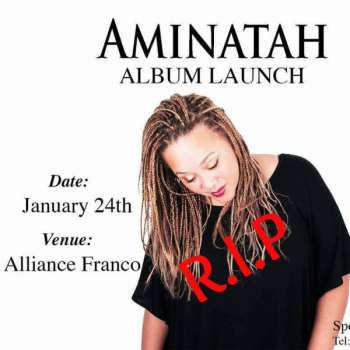
Aminata Baldeh, one of The Gambia's finest female singer, has passed away. Sources report that her sudden death occured on thursday, March, 9th, 2017.
The Swedish born Gambian singer has done a lot of collaboration songs with top Gambian musicians including Gibou Bala Gaye, Vypa Skinny Boy fly and many others. She is one of the few female artists who actually released their own album. A true Gambian pride indeed.
Early Thursday, March 9th, 2017, social media was saturated with messages of condolences for Aminata's family. Cause of death is yet to be released. According to Jatou Mbowe, a.k.a ThaBoss chick, she saw Aminata 2 days ago from March 9th, 2017 on a facebook status update.Aminatah Baldeh is a Swedish singer with a Gambian father. She was about 28yrs of age. She sang mostly R&B. Check out her video below.
Our condolences goto the Baldeh family and the entire Gambian community in Germany, Sweden, and all over the world. May her soul rest in perfect peace.